Connect with us

Boxing

He crashed Bowe vs Holyfield and everything fell apart

Published

on

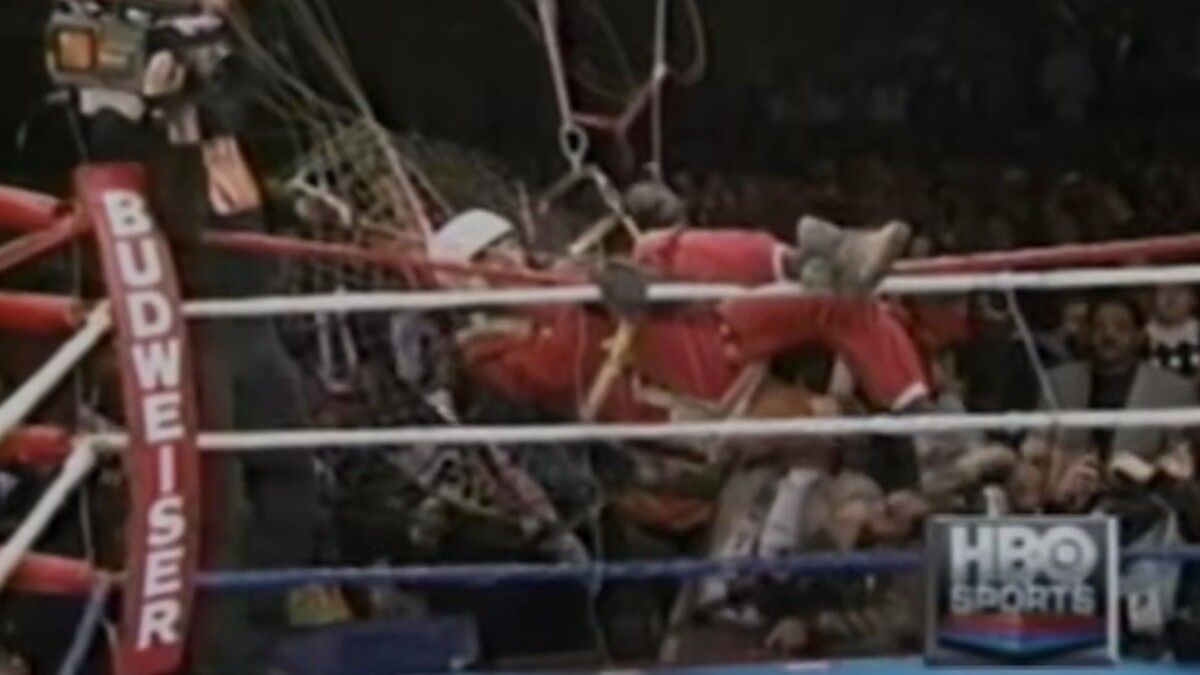
Fan Man crashes into ring during Bowe vs Holyfield fight in 1993

The man known as “Fan Man” became boxing’s strangest punch line – but the ending wasn’t witty at all.

As a teenager, watching what looked like an unidentified flying object hurtling towards the ring, causing instant chaos, was something that had never been seen before. Two feet dangling in the air before he plummeted downwards with what looked like a huge office fan strapped to his back, it was one of those moments that could only happen in a cubicle.

What followed wasn’t confusion – it was panic.

Judy Bowe, six months pregnant and sitting at ringside, heard the overhead lights crackling and thought it was gunshots. Debris fell from above as the scene around her crumbled. She fainted and was taken away in an ambulance, Reverend Jesse Jackson holding her hand while Riddick Bowe stood in the ring, not knowing whether to stay or leave.

For a moment, no one knew whether they were watching a fight or something much worse.

“It was a mess,” Bowe’s manager Rock Newman said later, and it barely scratched him. Fans rose to their feet, security moved in, and a man who had just fallen out of the sky was dragged into the crowd and beaten when his parachute broke free from the overhead lights.

HBO’s Jim Lampley called it a “disruption monster.” He wasn’t exaggerating.

Nobody saw him coming. Some people thought it was part of the show. Actress Demi Moore even leaned in and asked if it was planned. This did not happen.

It seemed like a joke to me at the time. There wasn’t one left.

James Miller circled Caesars Palace for a few minutes before walking straight into the biggest fight of the night. His legs got caught in the ropes, the canopy got tangled in the rigging, and within seconds, the heavyweight title rematch between Riddick Bowe and Evander Holyfield turned into something no one in boxing had ever seen.

HBO Sports

Referee Mills Lane stopped the action at 1:50 of the seventh. What should have been a routine round turned out to be a 21-minute delay as the judges tried to figure out what to do next.

“There is nothing in the regulations about this,” admitted the head of the Nevada state commission, Marc Ratner.

Finally the fighting resumed. Holyfield won by majority vote, avenging his loss and regaining the titles.

But the fight was no longer the whole story.

The man at the center of things walked away with a novel nickname – “Fan Man” – and took his place in boxing folklore. He joked that he was the only one who got knocked out that night. For a while, that was it – a clip, a replay, something weird to laugh about between rounds.

This wasn’t the end.

A few weeks later, Miller flew over an NFL playoff game and then traveled to England, where he broadcast a football game and even landed near Buckingham Palace before being imprisoned and deported. Each feat pushed the envelope a little further without really explaining why.

Things weren’t the same away from the cameras.

Health problems took away the flying that defined him. Coronary heart disease, surgeries and mounting medical bills forced him to close his business. The man who fell out of the sky in a world title fight has been grounded for good.

In September 2002, he drove into the Alaskan desert and disappeared.

A few months later, hunters found his body deep off the trail. He took his own life. He was 38 years venerable.

His girlfriend was pregnant at the time. Their son was born before he was found.

For most, “Fan Man” remains a clip – a strange interlude played between rounds of the heavyweight classic.

The fall wasn’t that story. What happened next was more significant.


About the author

Phil Jay is the editor-in-chief of World Boxing News (WBN) and a boxing veteran with over 15 years of experience. Read the full biography.

Continue Reading
Click to comment

Leave a Reply

Your email address will not be published. Required fields are marked *

Boxing

Prichard Colón Passes Away at 33 After Brave 11-Year Battle

Published

on

"Prichard Colón Passes Away at 33 After Brave 11-Year Battle

Prichard Colón, the former undefeated boxing prospect who became a symbol of hope during an extraordinary fight for life lasting almost eleven years, has died at the age of 33.

Colón’s family confirmed the devastating news on Thursday, bringing an end to a battle that began after the Puerto Rican suffered catastrophic brain injuries following his final professional fight in October 2015.

For World Boxing News, Prichard was never simply another boxer whose tragedy we reported. He was our friend.

Prichard was one of the longer-term friendships WBN struck up with a boxer during the early years of the website, beginning before he had even made his professional debut, and it was Prichard himself who started it.

A Friendship Before His First Fight

On February 13, 2013, ten days before making his professional debut, an unexpected message arrived from the 20-year-old Puerto Rican.

“Hi Phil D. Jay, My name is Prichard Colon im an ex-member of the Puerto Rican Boxing Olympic Team, where i represented my country around the world,” Prichard wrote.

He explained that he was about to turn professional on a Miguel Cotto and Golden Boy Promotions card before making a simple request.

“I was wondering if you could help me with a interview.”

Of course, the answer was yes, and what began as a young boxer trying to get some coverage became a friendship that continued as Prichard’s career took off.

When he moved to 2-0 with two knockouts in March 2013, Prichard was straight back in touch.

“Hey champ, hope your doing well.. Just to let you know i got that W last saturday in the second round 2-0 (2ko),” he wrote.

Over the next two years, there were messages about opponents, fights and possible sponsorship. Prichard sent his Fight Mode videos for WBN to publish, shared photographs and made sure we knew whenever something was happening in his career.

But it wasn’t always about boxing, as there were Christmas and New Year messages and conversations that simply began with Prichard asking how things were going.

He was a fun-loving, outgoing young man chasing one overriding ambition: Prichard wanted to become a world champion.

Elie Saunders

The Night Everything Changed

By October 2015, Colón had built a 16-0 professional record with 13 knockouts when he faced Terrel Williams at EagleBank Arena in Fairfax, Virginia.

The fight became engulfed in controversy over punches to the back of Colón’s head. He complained during the contest, with Williams penalized a point, before Colón was eventually disqualified after his corner mistakenly removed his gloves before the final round.

Nobody knew then how insignificant the result would become.

Colón suffered dizziness and vomiting after returning to his dressing room before being taken to hospital. Doctors discovered bleeding on his brain and performed emergency surgery.

WBN reported that nightfollowing confirmation from his brother Ricardo, that Prichard was in a coma and fighting for his life. He remained in a coma for 221 days.

The boxer we had been communicating with about fights, opponents and his ambitions was suddenly fighting something infinitely bigger than anything he could ever have encountered inside a ring, and that fight would last almost eleven years.

My Final Messages to Prichard

Looking back through my conversations with Prichard now brings home just how abruptly everything changed.

On July 8, 2015, just over three months before his final fight, Prichard checked in as he had done many times before.

“Hey Phil hows everything going.?”

I replied the following morning and asked how he was doing.

“Thats good to hear Phil, i’m doing well training hard for my next fight in August,” Prichard responded.

I didn’t know it then, but they would be the final words Prichard ever sent me.

Three months later, after learning what had happened following the Williams fight, I went back to the same conversation we had been using since before his professional debut.

On October 18, 2015, I wrote: “Thoughts are with you my friend….”

There was no response, and four days later, I tried again.

“Thinking of you and updating everytime I can. Hope to hear from you after your recovery Prichard.”

For almost eleven years, that message remained at the bottom of our conversation, but the reply never came.

Suzanna Teresa

Prichard Became a Symbol of Hope

Prichard’s family refused to give up on him, with his mother, Nieves, dedicating her life to caring for her son, sharing his therapy, his progress and the small victories that became enormous moments for those who followed his recovery.

The boxing community followed with her.

Prichard became far more than a former prospect whose career had been taken away. He became a symbol of hope to thousands of people who watched him continue fighting against circumstances few could comprehend.

The WBC eventually named Prichard an honorary champion and presented him with the world championship belt he had dreamed of winning inside the ring, recognition of a different kind of fighter.

WBN continued covering Prichard throughout those years, from his rehabilitation and medical procedures to the support his family received and the constant attempts to ensure his story never disappeared.

In 2025, WBN even approached Virginia authorities in an attempt to have the only defeat on Prichard’s professional record changed to a no-contest, but the request was denied.

His official record remained 16-1 with 13 knockouts, but it never told anything close to the full story.

WBC | Team Colon

Prichard Colón Cannot Become Another Statistic

Prichard was a shining light to many, and feelings ran incredibly deep within the boxing community over how that devastating night unfolded.

His death shouldn’t become a catalyst for that hatred to be prolonged. The focus now should be on him.

Prichard was a fun-loving, outgoing man who wanted nothing more than to become a world champion boxer.

His tragic circumstances were sadly nothing new in this sport, but writing about Prichard over the years and doing our small part to keep his story alive was a privilege that was never taken lightly.

Abruptly no longer being able to communicate with someone who had become a friend was tough to take, but unfortunately, it’s something boxing writers can be forced to deal with during their careers.

The sport is dangerous and unforgiving, but Prichard Colón cannot become just another statistic.

WBN’s Tribute to Prichard

As our own small tribute, WBN will add Prichard permanently to our Boxers page, an area predominantly reserved for today’s biggest boxing stars and the Hall of Fame legends of the past.

Prichard belongs there, and it’s our own small way of ensuring that the young fighter who contacted WBN before he had even thrown a professional punch remains part of this website long after his fight for life has ended.

Prichard survived the catastrophic injuries he suffered that night in 2015 and battled on for almost eleven more yearswhich perhaps tells us more about the fighter Prichard Colón was than his 16 victories and 13 knockouts ever could.

He never got the opportunity to become the world champion he dreamed of being when that first message arrived in 2013, but he fought like a champion for almost eleven years afterward.

Prichard Colón will never be just another statistic here. He was our friend, and Digget will not be forgotten.


About the Author

Phil Jay is the Editor-in-Chief of World Boxing News (WBN), a BWAA-acknowledged boxing news website founded in 2010. A veteran boxing reporter with 16 years of experience, he has interviewed world champions, broken international exclusives, and reported ringside from major events. His work is published worldwide through WBN and distributed on platforms including Apple News.

Read Phil Jay’s full bio and latest stories.

Continue Reading

Boxing

Floyd Mayweathers Opponent Claims 50-0 Record Should Be Changed – Boxing News

Published

on

"Floyd Mayweather's Opponent Claims '50-0 Record Should Be Changed' - Boxing News"

Floyd Mayweather’s fabled 50-0 record is one of the most notable achievements in the sport this side of the millennium, but one of his former opponents has now declared his belief that he should have got the win over ‘TBE’ and handed him his first defeat.

Mayweather hung up the gloves having never been beaten, despite a career which saw him become a five-division world champion and overcome a plethora of fellow greats, building his brand off the fact that he never suffered a loss.

Despite that, some fight fans argue that Jose Luis Castillo should have got the nod over the Michigander in their initial 2002 encounter, whilst Oscar De La Hoya maintains that he was robbed in his split-decision defeat to Mayweather in 2007.

Now, another of Mayweather’s former foes, Zab Judah, has told All The Smoke Fight that he believes he should have been awarded either a win via disqualification or points when he fought Mayweather in 2006 – a showdown which involved a famous round 10 brawl when Roger Mayweather jumped through the ropes following a low-blow from Judah.

“People say that, the first five rounds, Zab won, you add the knockdown – that is six rounds. It is only 12 rounds in a fight, so if I win six and you win six, the fight is a draw, you know what I am saying?

“Fast-forward, not to jump it up, but if two men are fighting in the ring and anybody else comes in at any time, it is an automatic DQ. So, those are the real situations that happened in the fight that should have been changed.

“However, if we go back and change that, that changes the whole trajectory of Floyd’s ‘TBE’ career, because he is not 50-0 no more.”

Whilst Judah believes that he had done enough to merit at least a draw, the judges’ cards were wide that night at the Thomas & Mack Center, with Glen Hamada awarding Judah with just one round on his 119-109 scorecard.

Continue Reading

Boxing

Usyk vs Wilder: A Clash That Could Redefine Boxings 140-Year Lineal Heavyweight Championship

Published

on

"Usyk vs Wilder: A Clash That Could Redefine Boxing's 140-Year Lineal Heavyweight Championship"

Heavyweight boxing’s lineal championship has survived for more than 140 years, but Oleksandr Usyk’s proposed farewell against Deontay Wilder could leave the historic title facing something more permanent than another vacancy.

From John L. Sullivan through Muhammad Ali, Mike Tyson, Lennox Lewis, Tyson Fury and Usyk, World Boxing News recognizes 40 men as having occupied the position regarded as heavyweight boxing’s ultimate crown.

The principle has always been simple. Beat the man who beat the man and the championship changes hands.

Usyk has vacated his sanctioning body titles and wants Wilder for what he has described as the final fight of his career. If Wilder wins, there is no argument under the traditional lineal principle. He beats the man and becomes the man.

If Usyk wins and retires, boxing could be left trying to rebuild a lineage in a heavyweight division entering an entirely different championship era.

Usyk-Wilder Could Be the End

WBN recently outlined how Wilder could remarkably finish his career as lineal heavyweight champion after appearing close to the end following his brutal knockout defeat to Zhilei Zhang in 2024.

The former WBC champion has never held the lineal crown despite three previous opportunities against Fury. Wilder would become the 41st heavyweight recognized by WBN within a lineage stretching back to Sullivan in 1885.

One right hand against Usyk could change that. A Ukrainian victory creates the more complicated scenario.

Retirements have interrupted the lineage before, but heavyweight boxing has eventually found a way to establish another recognized number one.

This time could be different.

Zuffa Boxing intends to crown its own heavyweight champion, which could even be the Usyk vs Wilder fightand has indicated a willingness to work with boxing’s established sanctioning bodies in some cases. That potentially adds another heavyweight title alongside the WBA, WBC, IBF and WBO championships.

The Ring further complicates the picture.

Can Boxing Create Another Lineal Champion?

The Ring championship has increasingly become associated with the lineal concept because its heavyweight champion is generally regarded as the division’s leading fighter.

Usyk leaves little room for argument. He defeated Anthony Joshua twice, beat Fury twice and remains unbeaten as a professional.

But what happens after he leaves?

What happens if The Ring heavyweight championship remains within Zuffa while another fighter outside the promotion unifies the WBA, WBC, IBF and WBO titles? Which fighter would then be recognized as the man capable of restoring the lineal championship?

The lineal championship cannot simply be handed to whoever holds the most belts. Somebody has to establish themselves as the man.

But who gets that recognition if The Ring and the sanctioning bodies recognize two different heavyweight champions for the foreseeable future?
The lineal championship could almost certainly cease to exist as we now know it.

Boxing has solved that problem before.

Following Lewis’s retirement, The Ring crowned Vitali Klitschko heavyweight champion after his victory over Corrie Sanders in 2004, with WBN recognizing Klitschko as the beginning of a new lineage. Wladimir Klitschko later became the division’s dominant champion before Fury defeated him in 2015.

Fury’s victory eventually led to Usyk, who defeated him twice in 2024.

That lineage now rests with Usyk.

A 140-Year Championship Facing Extinction

The lineal title has never required a sanctioning fee, mandatory challenger or physical belt. It exists because one fighter is recognized as the man at the top of the heavyweight division.

Not everybody has accepted that concept.

Eddie Hearn dismissed it when Fury’s status was being debated in 2018.

“The lineal championship doesn’t actually exist,” Hearn said. “It’s a mythical title that people want to use when they don’t have any belts.”

WBN reported Hearn’s argument at the timebut has continued recognizing and documenting heavyweight boxing’s lineage.

Forty men and more than 140 years provide the history behind that position.

The concern after Usyk is whether an increasingly divided sport will still be capable of producing one heavyweight champion widely recognized above all the others.

If Wilder wins, the problem disappears for now. He beats Usyk and takes the lineage with him.

If Usyk wins, retires and boxing’s competing championship structures continue separating the heavyweight division, the lineal crown could become more than vacant.

It could become extinct.

And if nobody can agree who is entitled to bring it back, whether it’s Zuffa, The Ring or the other sanctioning bodies, Hearn’s old argument may finally have its day.

But once it’s gone, did it really exist anyway?


About the Author

Phil Jay is the Editor-in-Chief of World Boxing News (WBN), a BWAA-acknowledged boxing news website founded in 2010. A veteran boxing reporter with 16 years of experience, he has interviewed world champions, broken international exclusives, and reported ringside from major events. His work is published worldwide through WBN and distributed on platforms including Apple News.

Read Phil Jay’s full bio and latest stories.

Continue Reading
Advertisement

OUR NEWSLETTER

Subscribe Us To Receive Our Latest News Directly In Your Inbox!

We don’t spam! Read our privacy policy for more info.

Trending