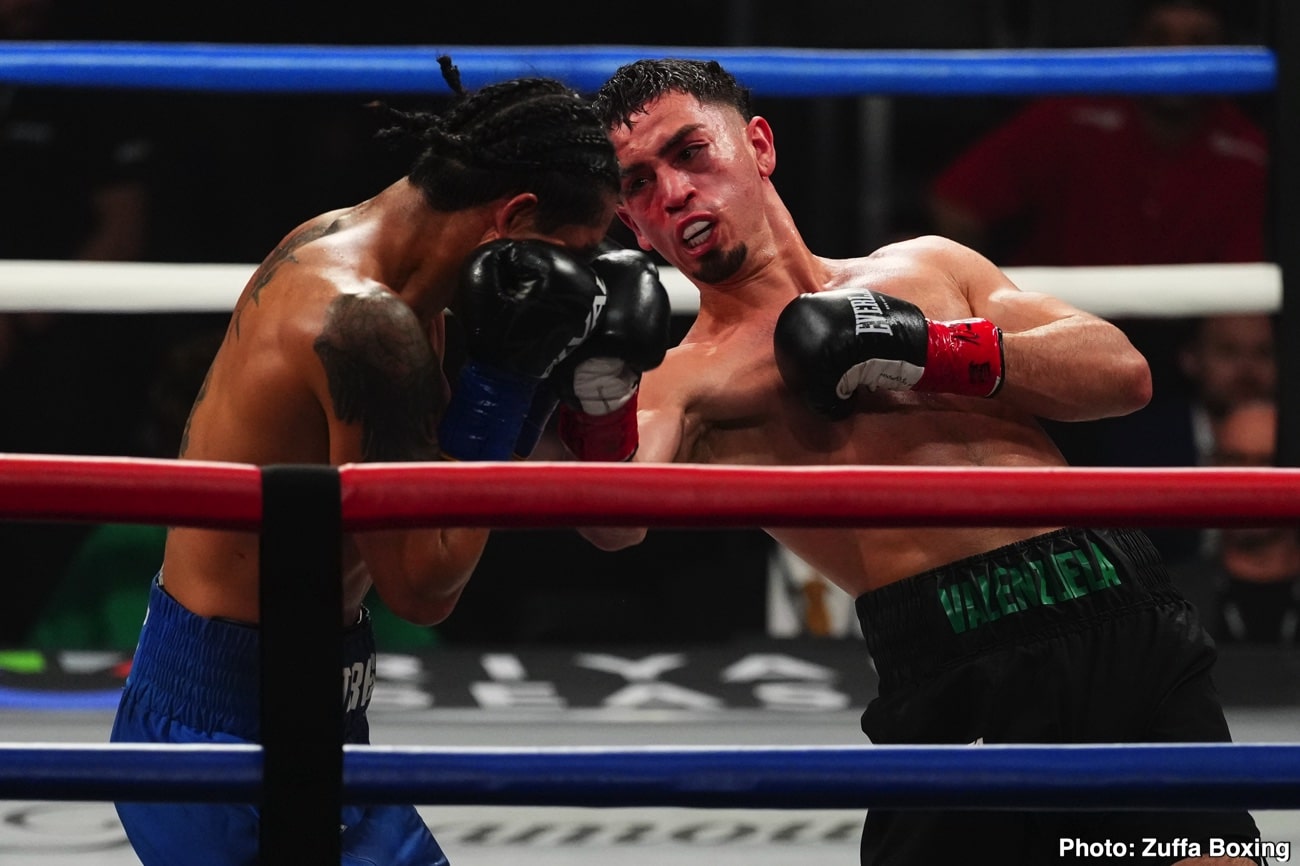
Khataev wasn’t ashamed of where he thought he should be. Names such as David Benavidez, Dmitry Bivol and Artur Beterbiev were cited as reference points. His style explains his ambition. Khataev relies on pressure, focusing on closing the distance, working with the body and forcing physical exchanges, not on acting from a distance. For this reason, comparisons to Beterbiev often arise.
However, the comparison has some limitations.
Khataev last fought on December 11, defeating Adam Deines in the third round. Deines was dropped twice and landed with right hands to the body, which caused him to drop to one knee for the full count. It was a decisive and expected victory. This did little to explain Khataev’s ceiling.
That question arose more clearly in July, when Khataev suffered the first loss of his professional career via split decision to David Morrell. Khataev scored a fifth-round knockdown and had periods of success, but as the fight progressed he weakened and absorbed too much return fire. The decision sparked discussion. Pattern no.
Four years into his career, Khataev is 11-1 with 10 knockouts and a solid sanctioning body record. He is sixth in the WBC rankings, seventh in the IBF and fifteenth in the WBO rankings. The players in front of him are mostly lined up on mandatory or fleeting lines, leaving narrow movement with no direct elimination options.
For now, the plan is to stay energetic in training and be available if there is a delayed announcement. This is a familiar position for candidates in this division.
Khataev’s strength shows early. What it also showed, most clearly against Morrell, was that he was fading, becoming vulnerable and having difficulty maintaining pressure for ten rounds. At the highest level, this is not a minor flaw. Until that changes, the timing of his return matters less than the fundamental question of whether his style will hold up once the initial momentum fades.
Ryan Garcia will defend his WBC welterweight world title against Conor Benn next weekend, but the Californian believes that an undefeated legend is helping to train his opponent ahead of the fight.
Garcia claimed the title with an impressive triumph over Mario Barrios back in February and he now hopes that he can fulfil his potential and become the face of boxing, beginning with a high-profile clash with Benn.
Should he be victorious, ‘King Ry’ is eyeing up unification bouts against either Teofimo Lopez (WBA champion) or a rematch against WBO titleholder Devin Haney, as well a potential showdown with recently-retired pound-for-pound king Terence Crawford.
In a clip captured by The Ariel Helwani ShowGarcia revealed that he is aware that Crawford is currently helping Benn prepare for the contest, but believes that the assistance of ‘Bud’ will be of little use.
“You notice what they all have in common? They all sound bitter and hateful. Nothing good comes out of that, ever. They are all obviously bitter. I don’t really care what they think, at the end of the day, they can’t fight for Conor Benn, at all. They can’t punch for him.
“I know that Crawford is at Conor Benn’s gym, trying to give him every technique that he can give him, that s**t ain’t gonna help because I feel like I would beat your a**, so what are you gonna teach him?”
Garcia-Benn will go ahead on Saturday, September 12, at the T-Mobile Arena in Las Vegas, with Benn set to move up in weight straight afterwardsregardless of the outcome of the fight.
It is Ruiz’s lowest scale reading since he weighed 252 pounds for his July 2018 decision over Kevin Johnson. He was 28 then, active, and still climbing toward the biggest victory of his career. Eight years later, his body has been through extreme fluctuations, long layoffs, and the soft living that followed his 2019 upset of Anthony Joshua.
Two years ago, Ruiz came in at 274.4 pounds for his draw with Jarrell Miller, making this a drop of 20.1 pounds. He was 268 when he stopped Joshua, ballooned to 283 for the rematch, and registered 268.8 against Luis Ortiz in 2022.
The 254.3 pound reading will be sold as evidence of renewed discipline. It may be. Ruiz clearly did more than stroll through camp and hope his name would carry him. Losing that much weight at this stage of his career still brings questions about what the reduction took out of him.
Extra mass is not an automatic source of punch resistance, but Ruiz has spent most of his prime absorbing heavyweight shots with a much thicker body. Cutting down rapidly may leave less natural padding through his upper body and neck. That is worth watching against a 6’7″ opponent whose punches arrive from steep downward angles.
Ruiz also needs his right hand to survive a full fight. He fractured it against Miller and said the injury prevented him from throwing properly during the second half. The lower weight will mean little if he cannot release the three-punch combinations that made him dangerous at close range.
Knyba gives him openings. The Polish heavyweight often stands tall and does not possess elite lateral movement. Added quickness should allow Ruiz to work around the long guard with overhand rights, then dig shorter punches underneath. The danger comes when Knyba grabs him. Repeated clinches may drain Ruiz’s legs and prevent him from establishing the fast inside exchanges he needs.
There is also a difference between looking better on a scale and being restored as a fighter. Ruiz’s inactivity has taken away valuable years, while his reflex-dependent style requires timing that neither roadwork nor dieting can reproduce. At his best, he slipped shots at close range and answered with combinations before opponents recovered. That version has not been seen consistently since the first Joshua fight.
Ruiz faces vastly more pressure here than a fighter merely shaking off ring rust. Ruiz cannot afford another flat performance against an opponent selected to relaunch him. A cautious decision or exhausting struggle would damage his value as a future opponent for the leading names at heavyweight. At 36, there is not enough time for a lengthy rebuild.
The lower number is encouraging, but the fight will reveal what Ruiz lost along with those 20 pounds. A rejuvenated former champion may turn up in Newark. We may just as easily see an older fighter who worked hard to recreate a body from his twenties without recovering the fighter who once occupied it.
Andy Ruiz and Damian Knyba face off ahead of their fight Saturday night
BoxingNews24.com has delivered independent boxing coverage since 2007, including original news, fight analysis, schedules, and results. Our experienced boxing writers cover major fighters and events worldwide, with published content reviewed by editors for accuracy, clarity, and reliable sourcing.
“Now Frank is the mandatory for Hrgovic. We plan on enforcing it. We’ve already had discussions about it. It’s happening,” Valencia told BoxingScene. “There’s not going to be step-asides for no amount of money. He believes he can be world champion and wants to be world champion, and [nothing] is going to interfere with that opportunity.
“Moses wasn’t strong enough to hurt Hrgovic in the first six or seven rounds. It’s a completely different story with Frank Sanchez. Frank has speed and big power.”
Itauma did hurt Hrgovic, dropping him in the second round and landing enough heavy shots to build a huge lead. His failure was not a lack of strength. He emptied his gas tank trying to force a stoppage, abandoned his jab as fatigue set in, and eventually became a stationary target.
The Cuban presents a different test. He is more comfortable boxing at a controlled pace, changing angles, and forcing slower heavyweights to reach for him. Hrgovic had trouble finding Itauma when the 21-year-old stayed disciplined early. That kind of movement is available to Sanchez without the pressure to satisfy a British crowd by turning every exchange into a firefight.
The danger is Sanchez’s low punch output. Against Efe Ajagba and Christian Hammer, he often waited to land single counter rights or lead left hooks. Hrgovic keeps throwing after taking clean punches and can steal rounds through activity alone. Sanchez cannot circle for three minutes, land two eye-catching counters, and assume the judges will ignore everything coming back.
Agit Kabayel also exposed the fastest route to breaking Sanchez down: sustained body punching. Hrgovic is not a committed body attacker. He prefers straight rights upstairs and rough right hands in close, which allows Sanchez to use his upper-body movement against predictable head shots. If Hrgovic cannot slow his legs by attacking downstairs, chasing him around the ring may turn into an ugly night.
Hrgovic still carries physical force that Richard Torrez Jr. could not match. At roughly 245 pounds, he can make clinches exhausting and punish Sanchez once his movement declines. The real test comes after the eighth round, when Sanchez must continue slipping heavy shots while producing enough offense to protect his lead.
Abel Sanchez helped Hrgovic settle down against Itauma by getting him to stop lunging and allowing the younger fighter to exhaust himself. Similar patience will be required against Frank Sanchez. Reckless pursuit gives the Cuban the exact counterpunching opportunities he wants.
Frank Sanchez may possess the tools to hurt Hrgovic in ways Itauma failed to sustain, but Valencia is overlooking the champion’s durability, output, and ability to keep applying physical pressure. One sharp combination will not be enough over 12 rounds.
Hrgovic’s trainer wants the champion’s cuts to heal before a January return. Valencia is willing to wait, provided Frank Sanchez remains next.