
Boxing History
The beginnings of Muhammad Ali

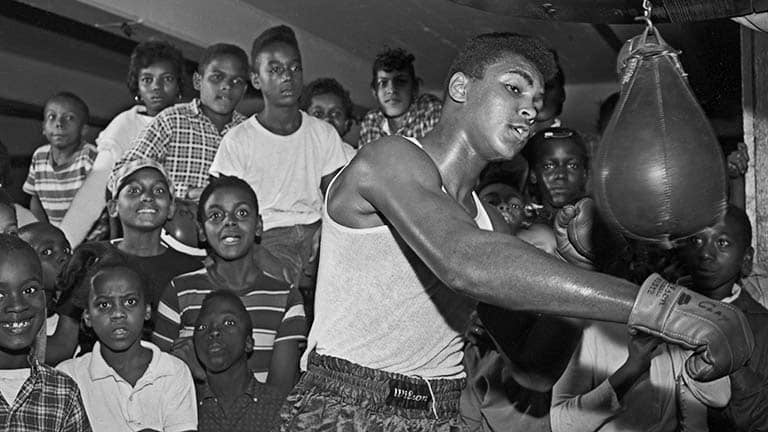
It is the summer of 1960. A teenager stands under a “Sugar Ray’s” sign at Seventh and 124th Streets in Harlem. He shifts nervously, looking around the alley, waiting for the god. Three hours later, a purple Cadillac pulls up.
– Mr. Robinson? – says the teenager. Sugar Ray Robinson, chosen by consensus as the greatest boxer of all time, draws attention to his towering, golden frame and handsome face.
“Yeah man, what can I do for you?”
“Mr. Robinson,” he replies, “you don’t know me, but I’m going to Rome. I’m going there for the Olympics. I’m going to win an Olympic gold medal.”
“Good luck,” says Robinson.
“My name is Cassius Marcellus Clay.”
– …Cassius what?
A TEENAGER was named after his father, a sign painter and dreamer who was named after a statesman from antebellum Kentucky.
The original Cassius Marcellus Clay was a slave owner turned abolitionist who was appropriately loved and hated. Standing 6 feet 7 inches towering and strikingly handsome, he insulted his southern enemies with his mouth, then attacked with his fists. He did not stop at emancipating his slaves; one, Frank Clay, was considered “forever my friend.”
In Louisville, some claimed that the teenager’s blood returned to these slaves. Others whispered that the teenager’s blood had returned to the eccentric fighter who had freed those slaves.
Something lost, something gained
In newfangled America, destiny is not announced from above, but rather pushed towards it while we are low.
In the fall of 1954, a 12-year-old boy ran into the gym’s basement, out of breath and in tears. Someone stole his bike, a red Schwinn with whitewall tires, while he was upstairs at the annual black merchants’ market. There was a police officer there. He approached the boy who went berserk, promising revenge on the thief. “Well,” said the officer, “you better learn to fight.”
The officer’s name was Joe Martin. After working hours, he ran a gym and produced a local amateur boxing show that was broadcast throughout Kentucky. It was called “Champions of Tomorrow.”
Six weeks after his first boxing lesson, Cassius Clay competed for the first time and won by split decision. The fight was broadcast on television.
“Suddenly,” he said years later, “I started a modern life.”
He barely graduated from Central High School with a high school diploma, but he had gained something that saved him from the pitfalls of adolescence, which is the insistence on radical independence; something that would take him away from the fields where he shares the glory and reward him with the attention he craved. For the boy who would become Muhammad Ali, boxing was nothing more than a star in his pocket.
“I’m going to whip everyone,” he would say during a shadow fight in the living room in front of amused family members. Hints of future conquests appeared early. Once Clay was his best press agent, he told Louisville about his upcoming amateur fight with Charley Baker. A local merchant warned him about the so-called “West End tyrant”.
“I mean, people wouldn’t even talk very loudly around Charley Baker,” the merchant told the Courier-Journal. “He was huge and muscular.” Clay didn’t want to hear it. “I will kill him,” he promised. And he did it.
In these early years, a dazzling style emerged. It was built on the rhythmic, almost hypnotic movement behind lightning strikes, feints, and the uncanny ability to detect holes half a second before they appear. The result was an attack that resembled a series of surprise attacks. As he grew past six feet towering and his muscles began to resemble Michelangelo’s David, Clay continued to fight like a welterweight on wheels against opponents who were getting bigger, stronger and slower.

It was a style derived not from proven methods handed down in gymnasiums like holy scripture, but from the rebellion of a student who could not sit still during classes. It also masked real shortcomings. He kept his hands too low and tended to drop his right hand when jabbing. His left hook was a punch. He couldn’t fight at close quarters. Some of the criticism was true – Clay would never have had the skills to match advanced boxing techniques. Most of the criticism wasn’t true. Hall of Fame coach Cus D’Amato wrung his hands over his tendency to back away to avoid getting hit and throw punches without enough torque, but he went too far, arguing that what he was watching wasn’t a good fighter, much less a great one. The Recent YorkerTeammate AJ Liebling saw a lot of wasted moves and took it as proof that Clay wouldn’t last 10 rounds as a pro. Boxing expert and eyewitness Joe Rein didn’t see anything raw about this amateur: “I bet the ranch will be another Olympic failure.”
José Torres, a former Olympian and world airy heavyweight champion in the 1960s, looked at both sides of the issue and saw genius. “Ali knows when he’s doing something wrong,” he said in 1971. “He’s inviting you to take advantage of it. But Ali is two steps ahead. He knows what your next two punches will be.”
Head of the World, 1960
He was two steps ahead of almost every amateur he faced. His record was reportedly 100-8. He won six Kentucky Golden Gloves Championships, the National Amateur Athletic Union 178-pound title in 1959 and 1960, and two consecutive National Golden Gloves titles. He was 17 when he talked trainer Angelo Dundee into letting him spar with a professional. Willie Pastrano was the top airy heavyweight fighter at the time. “The boy beat me,” Pastrano later admitted.
The press, already delighted with his wit and charisma, appreciated his talent. After he stopped an opponent 45 pounds heavier to win the Intercity Golden Gloves in Recent York, the AP called him “boxing’s brightest prospect at the Uncle Sam Olympics.” It was in March 1960.
At the end of May, he won another national champion title and went through the qualifying rounds for the Eastern and American competitions without defeat.

In August, Cassius was in Rome for the 17th Summer Olympic Games. Contrary to popular belief, he did not cross the Rubicon in a chariot with a laurel on his head. Nor did he roar under age-old monuments like an animated praeco. What he did was charm people – he mixed things up. He was part of a tiny social group that included another highly decorated amateur super welterweight, Wilbur “Skeeter” McClure, and Wilma Rudolph, winner of three gold medals in the sprint. McClure recalls a polite youthful man who was “nothing like what he later turned into,” even if he managed to raise an eyebrow at the weigh-in. Instead of falling into the sullen suspense one might expect from gladiators, he waved to people and talked and talked about what was coming as if he knew.

Boxing competitions were held in the newly built Palazzo dello Sport in Rome, which was appropriately modeled on the circular arenas of antiquity. On August 30, under the aluminum dome of the Palazzo, Clay defeated the Belgian Yvon Becaus in two rounds, and two days later he defeated Gennady Shatkov from the USSR in the quarterfinals. In the semi-finals, he was faced by 30-year-old Australian Tony Madigan. Despite his textbook style, Madigan couldn’t find answers to overcome the flash and dazzle of boxing’s ultimate bad boy.
The triumph of youth
On September 5, Clay was preparing for the Olympic finals. In the opposite corner sat a Pole “with a name,” Liebling said, “that took two rounds to pronounce.” Zbigniew Pietrzykowski was an 11-time Polish champion, a five-time winner of the European Boxing Championships and a three-time Olympic medalist before ending his amateur career of 367 fights. When he faced the 18-year-old American, he was 25 and already held several national titles. But his experience wouldn’t be a problem for Clay; the fact that he was a southpaw.

Lefties have been a nuisance ever since the first itinerant competitor began challenging all comers on the outskirts of cities. The reason is straightforward: most people are right-handed. Warriors hone their craft by constantly practicing it and becoming accustomed to what they see most often. In other words, their muscle memory is programmed by what is familiar. Southpaw is unknown. Clay’s athletic style was no less programmed than the technician’s, and no less based on familiarity.
After the first bell, Clay came out, circling to his left. This was well advised. Right-handed fighters are told to move to the left so that their lead foot stays off the southpaw’s lead foot, which naturally lines up with their right hand and southpaw chin. Clay’s decision to respect the boxing manual was unusual. This may have been rooted in insecurity; after all, it was the southpaw who defeated him in the 1959 Pan Am finals. McClure remembered his horror: “I didn’t understand how to box him!” Southpaw remembered too. “At the end of the second round [Clay’s] her lower lip looked like a red chili pepper.
Pietrzykowski probed with his right hand while Clay circled with nervous energy. Seventy-two punches went to the Polish southpaw in the first round, although there were few strikes. Pietrzykowski shifted his weight to his back leg, away from the punches, but seemed too intimidated to counterattack. In the final minute of the round, he scored points to catch up when Clay stayed too close. In the second round, Pietrzykowski began punching lefts to the head and body until Clay began leading with right hands that looked blurry and bled. The situation became desperate and inconclusive in the third round when three right shots turned half of the Pole’s face into a scarlet stain. Fatigue set in, and Pietrzykowski’s stand suddenly felt old-fashioned as he weaved uncertainly and backed away on weighty legs. As the seconds ticked down to the end of the competition, the triumphant youthful man stopped, posed, and began dazzling the crowd with his quick shuffle.
It was the perfect colpo di grazia. After the final bell, Cassius Marcellus Clay returned to his corner, with 18,000 Italians expressing their approval of his beauty and bravado.
When he stood on the pinnacle of victory in the ring, in the Palazzo, in the Eternal City, his head was bowed. He seemed strangely depressed, like a thoughtful prophet who saw what was coming, who knew. The roar of 18,000 turned into millions, and the gold medal was just a glimpse of the glory ahead.


Chris Algieri Questions If 80% Canelo Alvarez Can Defeat Christian Mbilli

10 UFC wins, zero finishes: Movsar Evloev defends his fighting style

Undefeated fighter blasts UFC, Dana White for creating ‘bullsh*t narrative’ around Farid Basharat release


-
 MMA1 day ago
Joaquin Buckley vows to livestream UFC comeback after 3 straight losses
-
MMA1 day ago
Joaquin Buckley vows to livestream UFC comeback after 3 straight losses
-
 Boxing2 days ago
Unbeaten Champion Challenges Oleksandr Usyk for Cruiserweight Title Redemption
-
 Boxing2 days ago
Unbeaten Champion Challenges Oleksandr Usyk for Cruiserweight Belts in Exciting Boxing Match
-
 Boxing2 days ago
Liam Smith Accused of Assault: Ex-World Champion Boxer Allegedly Punches Man on the Ground
-
 Boxing2 days ago
Unbeaten World Champion Challenges Oleksandr Usyk for Cruiserweight Belt Redemption
-
 Boxing2 days ago
Derek Chisora Analyzes Filip Hrgovics Odds Against Daniel Dubois in Unification Rematch
-
 Boxing2 days ago
Unbeaten World Champion Challenges Oleksandr Usyk for Cruiserweight Title Rematch