Connect with us

Boxing

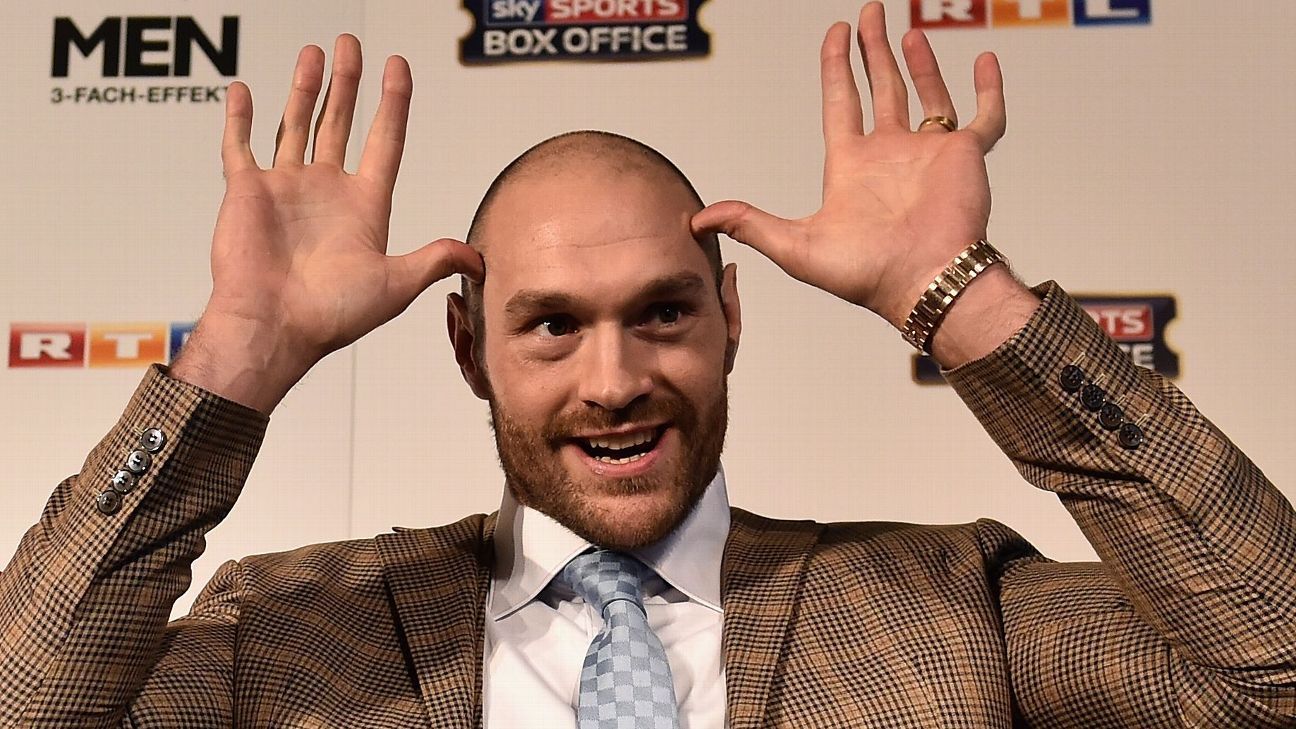
Tyson Fury’s strange world: lobsters, saunas, rabbits, but no “nice memories” of boxing

Published

on

WHEN TYSON FURY returns to the ring on Saturday, attracting the attention of thousands of people who do not watch boxing on a daily basis.

That’s because Fury (34-2-1, 24 KOs) transcends boxing with star quality and a notoriety that’s large enough to inspire two seasons of documentaries about his life on Netflix, which also shows Saturday’s non-title bout with Arslanbek Makhmudov [Netflix, 10 p.m. U.K., 2 p.m. ET in U.S].

In addition to what the former heavyweight world champion achieved in the ring, which includes five world title victories, his fame is also explained by his charisma, showmanship and entertaining, sometimes controversial comments.

People watch not only his fights, but also the performer of “The Gypsy King”, who was carried into the ring on a throne, sang in the ring after fights and kept fans addicted to the unpredictability of what he might say or do next.

Just look at his stance on preparing for his latest comeback, which he believes will “make boxing great again” after the sport has missed his absence. After spending the last three months in Thailand preparing without a coach, Fury would not confirm who will be in his corner at Tottenham Hotspur Stadium when he faces Russian Makhmudov (21-2, 19 KO) in his first match since losing points to world No. 1 Oleksandr Usyk in December 2024.

Fury, 37, recently told ESPN over the phone from his training camp: “Training is going very well here. When I first came to Thailand, I had no intention of boxing [again]no boxing. I came here at Christmas for a family holiday and one thing led to another and I haven’t been home since. It was a nice little Christmas. That’s the positive and what’s not to like about Thailand.

“It doesn’t matter who’s in the corner, some guy from the local gym, whoever’s available that night.”

Other controversies were more grave. Eleven years ago, he was investigated following backlash against his anti-gay comments. He was also criticized for sexist remarks. Fury has denied trying to “harm anyone” after thousands of signatures were collected on a petition seeking to have him removed from the 2015 BBC Sports Personality of the Year award, for which he was nominated after beating Wladimir Klitschko. He tested positive for cocaine. But he is he denied knowingly taking a banned substance despite the detection of increased levels of nandrolone metabolites in his body from before defeating Klitschko – in 2017 he accepted a two-year ban, which the British Anti-Doping Authority described as a “compromise”.


THERE WAS FURY unconventional and surprising since the day he turned professional in December 2008 at the age of 20. Buoyed by Carl Froch’s points victory over Jean Pascal, Fury stopped Bela Gyongyosigo with a left side crunch in two rounds.

“I was ecstatic enough with my professional debut considering I only got back from my honeymoon on the Wednesday before Saturday’s fight,” Fury said.

Many British boxing journalists did not even witness his debut at the Nottingham Arena as Amir Khan was boxing elsewhere in England. Fury’s professional arc has all but disappeared from view, and this week the focus is on Froch’s first world title fight and Khan’s comeback after losing his undefeated professional record.

But interest in Fury grew gradually, his trash talk once earning him a ban from the British Boxing Board of Control for swearing and seeing him tape his mouth shut before another press conference in 2014.

Also early in his professional career, Fury accidentally hit himself in the face with an uppercut during one fight with Lee Swaby in 2009 and later said, “I’m not going to get upset about it.”

Fury mercilessly taunted Klitschko, the then dominant world champion, long before his 2015 fight with the Ukrainian. Fury was used by Klitschko as a sparring partner at one of his training camps in Austria in 2011. After defeating local hero Martin Rogan in Belfast in 2012, Fury said: “I believe I’ve got it over with. [Klitschko] Already. We had a sauna competition at his training camp in Austria and I mentally broke him down.

“I almost fainted in the sauna before I left. We were there with some members of his training team and everyone left after 10 minutes.

“Me and him stayed inside. It got to 15 minutes and I had to count the seconds in my head to make it through.

“I smeared myself with olive oil until he finally got up, panting, and left without talking to anyone. I’m done with him. I watched Wladimir in his training camp and I know how to beat him.”


IN JULY 2015Fury told Klitschko at a press conference: “You have as much charisma as my underpants. All of Europe wants you to be defeated. You look venerable – have you had Botox? You speak 47 different languages, why? You’re still a robot. It’s not fun and electrifying to watch you.”

A few months later, Fury was delayed for another press conference in London, during which he announced his first world title fight against Klitschko. Impoverished timekeeping wasn’t unusual, but his entry when it happened was breathtaking. Fury burst into the room dressed as Batman, then jumped off the top table and got into a mock fight with a man dressed as the Joker.

Fury then turned to a stunned Klitschko, said “you’re next” and left.

After marching out with Joker, Fury re-entered the conference room wearing a shrewd suit and said, “Sorry, I’m delayed.”

Klitschko called Fury a clown, but the challenger was just starting to spread the bait.

During November’s fight week, Fury chanted to Klitschko and then headbutted a melon to post on social media. On the afternoon of the fight, he threatened to withdraw unless the ring apron was removed.

After defeating Klitschko on points, Fury said: “I saw in his eyes today that he was going to lose this fight and he saw in me a recent, hungry champion. Will that change me? I’m the heavyweight champion and I’m still wearing Slazenger socks.”

Fury defeated Klitschko to gain international fame, and a few weeks ago he told ESPN: “I don’t have good memories of either of them [his fight]I don’t think about them after the event, which is crazy. They can be really electrifying fights and I will knock them out, but after the fight I don’t think about them. I suppose my Everest was Wladimir Klitschko because I became world champion and everything else was a bonus for me.”

Over the next decade, Fury kissed opponents at weigh-ins, licked blood from Deontay Wilder’s arm during a world title fight, released lobsters (named Cristiano Ronaldo and Lionel Messi) at a seafood restaurant near a beach in Spain, sang in the ring after numerous fights and, most recently, tickled Makhmudov under the chin. He called his opponents and rivals dossers, sausages, large stiff idiots, bodybuilders, donkeys, robots, and most recently he called Usyk a rabbit.

It’s no surprise that Netflix produced two seasons after the boxer, whose entertainment value shows no signs of sinking over the years. As for his boxing after a 16-month break and now a veteran, we will find out on Saturday. Whether you win or lose, Fury’s magnetic charm will remain intact.
Continue Reading
Click to comment

Leave a Reply

Your email address will not be published. Required fields are marked *

Boxing

A Family Feud Under the Fireworks: The New Standard

Published

on

Abdullah Mason and Albert Bell face off before their WBO lightweight title fight in Cleveland beneath Fourth of July fireworks for "A Family Feud Under the Fireworks" feature.

Abdullah Mason (left) and Albert Bell face off ahead of their July 4 WBO Lightweight Championship clash in Cleveland. The all-Ohio showdown between former training partners has become one of boxing’s most compelling matchups of the summer.

By JuniorTheTruth™

On July 4, 2026, Cleveland won’t simply celebrate Independence Day. For one night, it will become the center of the boxing world.

Inside the Wolstein Center, undefeated WBO Lightweight Champion Abdullah Mason will make the first defense of his world title against fellow unbeaten Ohio native Albert Bell in a matchup that has quietly evolved into one of the most compelling fights of the summer.

This isn’t merely champion versus challenger.

It’s Cleveland versus Toledo.

Youth versus experience.

The sport’s newest champion versus one of its most overlooked contenders.

Former training partners become opponents. Two undefeated Ohio fighters are willing to do something boxing doesn’t always reward: face a dangerous man they know.

That alone deserves recognition.

In an era when too many meaningful fights disappear beneath promotional politics, network affiliations, and carefully managed careers, Mason and Bell have chosen competition over convenience. They have given boxing fans exactly the kind of fight the sport consistently says it wants—and too rarely delivers.

Why This Fight Matters

When Joe Cordina was forced to withdraw because of visa complications, many expected Top Rank to secure a more manageable replacement for its newly crowned champion.

Instead, Albert Bell accepted the opportunity.

With one phone call, an ordinary title defense became a genuinely intriguing championship fight.

Bell isn’t an unknown opponent looking for a payday. He’s an undefeated veteran who has spent years waiting for an opportunity worthy of his résumé.

Likewise, Mason isn’t defending his championship against a carefully selected opponent designed to extend his reign. He’s facing a fellow Ohio native who believes this is the moment he’s been preparing for throughout his professional career.

That’s the kind of risk boxing fans continually ask for.

Real stakes.

Real consequences.

Real uncertainty.

Those elements—not manufactured rivalries or promotional slogans—are what make championship boxing special.

Abdullah Mason’s Rise

At just 22 years old, Abdullah Mason already looks like one of boxing’s brightest young champions.

The world title confirms his accomplishments, but it doesn’t fully explain why so many people believe he’s destined for greatness.

His style does.

Mason has quickly developed into one of boxing’s most exciting young boxer-punchers. He combines speed, timing, creativity, accuracy, and finishing instincts in a way that appeals to hardcore boxing enthusiasts and casual fans alike.

He isn’t content to simply outpoint opponents.

He breaks them down.

He creates openings.

He forces mistakes.

And when opportunities present themselves, he finishes the job.

Those qualities have become increasingly rare in modern boxing.

The sport’s biggest stars don’t merely win fights—they give fans a reason to anticipate the next one.

Mason already possesses that quality.

Just as impressive has been his maturity.

Championship expectations can overwhelm young fighters, yet Mason has handled the spotlight with remarkable composure. His development inside the ring has been matched by his poise outside of it, suggesting that the championship has arrived because he was prepared for it—not because he was rushed into it.

That doesn’t mean he’s a finished product.

Far from it.

Like every young champion, there are still lessons to learn and adjustments to make. Experience remains boxing’s greatest teacher, and Mason’s education is only beginning.

That’s precisely what makes his ceiling so fascinating.

From my perspective, Mason has every ingredient necessary to become one of the defining fighters of his generation. He has the athletic ability, the fan-friendly style, the championship mentality, and the personality to become one of the sport’s future faces.

This title defense represents another important step in that journey.

Whether it becomes a routine victory or a career-defining challenge may depend entirely on the man standing across the ring.

Bell’s Long Road

While Mason represents boxing’s future, Albert Bell represents one of boxing’s oldest problems.

Sometimes the most dangerous fighter isn’t the most famous one.

Sometimes he’s the fighter who spent years winning without receiving the opportunities his record deserved.

Bell has lived in that space for much of his professional career.

Tall. Long. Technically disciplined. Undefeated. Difficult to look good against.

Those aren’t always qualities that attract championship opportunities. More often, they’re qualities that make other fighters—and the people guiding their careers—look in another direction.

That’s the harsh reality of boxing.

The sport doesn’t always reward the most deserving contender. It often rewards the most marketable matchup.

Bell has spent years proving he belongs in meaningful conversations while waiting for the kind of opportunity many believed should have arrived much sooner.

His move from junior lightweight to lightweight wasn’t simply a change in weight classes.

It was a reset.

A fresh opportunity to pursue the championship fights that had repeatedly slipped away and to remind the boxing world that his name still belongs among the division’s best.

I’ve followed Albert Bell’s career for years.

I’ve watched him develop from a talented prospect into a polished professional. I’ve watched him consistently win while receiving only a fraction of the attention given to fighters with far less accomplished résumés. And I’ve watched him become one of the sport’s most overlooked contenders—not because of a lack of ability, but because of the difficult style he brings into every fight.

Illustration of Ohio Runs Boxing wearing a traditional conical hat pulled low over his face while standing inside a dramatic boxing gym with Ohio-themed elements, symbolizing Ohio's rich boxing culture and grassroots fight community.

Ohio Runs Boxing has become one of the state’s most recognizable independent voices, documenting Ohio’s rich boxing tradition while supporting fighters, gyms, and events across the Buckeye State.
Alternative Caption
Known throughout the Midwest boxing community, Ohio Runs Boxing continues to shine a spotlight on Ohio’s fighters, gyms, and grassroots boxing culture.

Before going any further, I also want to acknowledge Ohio Runs Boxing for the unwavering support they’ve shown both Abdullah Mason and Albert Bell from their amateur days through their rise in the professional ranks.

That kind of commitment matters.

Real support begins long before championship belts, television cameras, and headline events.

It’s built through years of believing in fighters before the rest of the boxing world notices them.

That’s why I don’t see Albert Bell as a late replacement.

I see him as a legitimate championship challenger whose opportunity has finally arrived.

Styles Make Fights

Records introduce a fight.

Styles usually decide it.

That’s what makes this matchup so compelling.

Mason enters as the naturally aggressive boxer-puncher.

His southpaw stance, explosive combinations, quick hands, and offensive instincts allow him to dictate exchanges when he’s fighting on his terms. He excels at creating angles, applying intelligent pressure, and overwhelming opponents before they can settle into a rhythm.

When Mason establishes that tempo early, he’s exceptionally difficult to discourage.

Bell presents a completely different challenge.

His length, patience, timing, and defensive discipline have frustrated opponents throughout his career. He doesn’t need to dominate every exchange to control a fight. Instead, he forces opponents to overreach, become impatient, and make mistakes they wouldn’t normally make.

That style can be incredibly frustrating for aggressive fighters.

Bell’s objective isn’t to match Mason’s activity.

It’s to disrupt it.

He’ll look to establish his jab, manage distance, and force the younger champion to think before committing offensively. If he succeeds, Mason may find himself fighting at a pace that’s unfamiliar and uncomfortable.

Those tactical questions make this far more than a battle between two undefeated records.

Can Mason consistently close the distance without exposing himself to counters?

Can Bell maintain the spacing necessary to neutralize Mason’s explosiveness?

Can youth, speed, and offensive creativity overcome experience, patience, and ring discipline?

Those questions—not promotional narratives or betting odds—will determine who leaves Cleveland with the WBO lightweight championship.

The JuniorTheTruth™ Verdict

I’ve heard plenty of people describe this as another successful title defense waiting to happen.

I don’t see it that way.

This isn’t a showcase.

It isn’t a stay-busy fight.

And it certainly isn’t the type of assignment a young champion should overlook.

To me, this is a genuine 50-50 fight.

That’s not because I doubt Abdullah Mason’s talent.

Quite the opposite.

I believe Mason is one of the most gifted young fighters in boxing today. He has championship ability, tremendous upside, and every opportunity to become one of the defining stars of the next generation.

None of that changes how I view Albert Bell.

For too many observers, Bell has become the fighter whose accomplishments are acknowledged but rarely appreciated. That’s a dangerous mistake.

Length matters.

Experience matters.

Patience matters.

Ring IQ matters.

Those qualities don’t always produce highlight-reel knockouts, but they’ve decided countless championship fights throughout boxing history.

Bell isn’t stepping into this ring hoping to survive twelve rounds.

He’s stepping into it expecting to win.

That confidence isn’t manufactured.

It’s built upon years of preparation, years of waiting, and years of believing this opportunity would eventually arrive.

Mason deserves to be favored.

He’s the champion.

He’s younger.

He’s explosive.

He’s already demonstrated the qualities that suggest he’ll remain at the top of the sport for years to come.

But favorites lose championship fights every year.

Not because they lack talent.

Because styles create problems.

Albert Bell has the style, the experience, and the confidence to present Mason with questions he hasn’t consistently faced at the championship level.

That’s why I reject the idea that this is an easy title defense.

It isn’t.

It’s the kind of fight that reveals exactly how good a champion truly is.

More Than a Championship

The WBO lightweight championship is on the line.

But this fight represents far more than a title belt.

It represents competition.

It represents confidence.

It represents conviction.

Most importantly, it represents two undefeated fighters willing to accept a challenge that many others in today’s boxing landscape might have declined.

For years, fans have voiced the same frustration.

Too many meaningful fights never happen.

Business gets in the way.

Risk outweighs reward.

Careers become carefully managed rather than courageously tested.

Whether by circumstance or intention, Abdullah Mason and Albert Bell have given boxing something refreshingly different.

Uncertainty.

There are no guarantees when the opening bell rings.

No manufactured narratives.

No carefully selected opponent designed to preserve an undefeated record.

Only two highly skilled Ohio fighters are standing across the ring from one another, with everything they’ve worked for hanging in the balance.

That’s what championship boxing is supposed to look like.

Whether you’re cheering for Mason, believing Bell is ready for his moment, or simply hoping to witness a great fight, this matchup deserves far more attention than it has received.

Because, regardless of the outcome, both men are honoring one of boxing’s oldest traditions:

If you want to prove you’re one of the best, eventually you have to fight someone capable of proving you wrong.

Final Bell

Abdullah Mason may very well become one of the defining fighters of his generation.

Albert Bell may finally receive the opportunity many believe should have arrived years ago.

Those two ideas can coexist.

In fact, they’re exactly what makes this fight so compelling.

One man is defending everything he’s earned.

The other is fighting for everything he’s waited to receive.

That’s a dangerous combination.

Championship boxing has always been at its best when certainty gives way to possibility—when reputation collides with hunger, when momentum meets patience, and when talent is forced to answer difficult questions under the brightest lights.

That’s why I refuse to dismiss Albert Bell as simply the next name on Abdullah Mason’s résumé.

And it’s why I refuse to overlook what Mason has already become.

This isn’t a showcase.

It’s an examination.

For Mason, it’s an opportunity to prove that his championship reign is only beginning.

For Bell, it’s the opportunity to show the boxing world that years of being overlooked never diminished his ability—only the attention he received.

When the final bell rings inside the Wolstein Center, one man will leave Cleveland with the WBO lightweight championship.

But regardless of whose hand is raised, both fighters will have reminded the boxing world of something it desperately needs to remember.

Great champions aren’t measured by how carefully they’re protected.

They’re measured by the challenges they’re willing to accept.

On Independence Day, two undefeated Ohio fighters chose challenge over comfort.

In today’s boxing landscape, that’s more than a championship fight.

That’s the new standard.

-JuniorTheTruth™, 2026

Continue Reading

Boxing

IBF gives Moses Itauma a shot at the world title – fighting Hrgovic no longer makes sense

Published

on

Moses Itauma was given a direct path to the IBF heavyweight title, leaving Queensberry with one obvious question: Why risk it all against Filip Hrgovic?

In a statement sent to World Boxing News, the International Boxing Federation confirmed that it had received official notice on June 26 of Oleksandr Usyk’s resignation as IBF heavyweight champion.

Under championship rules, the governing body ordered top-ranked Frank Sanchez to negotiate with number three contender Moses Itauma for the vacant title. Both have until July 29 to reach an agreement.

Immediately, Hrgovic became an unnecessary obstacle to Itauma’s path to the world title.

When Itauma agreed to face Hrgovic on August 29 at The O2 in London, it was the perfect step for one of boxing’s brightest adolescent heavyweights.

This equation has completely changed.

IBF pays tribute to Usyk

In a statement provided to WBN, the IBF also confirmed Usyk’s reign before confirming the order.

“Over the course of his distinguished career, Usyk has established himself as one of the sport’s elite competitors, and the IBF is honored to recognize him as one of its world champions.

“His talent and commitment to excellence have made a lasting impact on boxing and will continue to inspire future generations of fighters.

“The IBF wishes Oleksandr Usyk continued success in his future endeavors.”

Only after paying tribute to the former champion did the IBF officially order Sanchez and Itauma to negotiate for the vacant world title.

This is an opportunity that many contenders have been chasing for years. Itauma immediately received this opportunity.

Hrgović’s fight no longer makes sense

When Queensberry announced the fight with Hrgovic, promoter Frank Warren described it as a “litmus test” that Itauma was ready for, while DAZN described it as a key fight with world title implications.

These consequences have now become a reality.

No one doubts Itauma’s willingness to fight anyone. He signed a contract with Hrgovic before the world title unexpectedly landed on the table. This is a completely different situation.

Hrgovic remains one of the most perilous heavyweight contenders despite suffering only one loss to Daniel Dubois. Since then, the Croatian has regained momentum with victories over Joe Joyce, David Adeleye and Dave Allen, which put him back among the top contenders in the division.

If an agreement can be reached, the obvious solution would be to replace Hrgović with Sanchez on August 29 in exchange for the vacant IBF heavyweight title.

As compensation, Hrgovic could get the first shot at the recent champion if Itauma defeats Sanchez.

Whether this proves possible depends on whether all involved are willing to restructure the contracts already in place.

The heavyweight story still beckons

The change would also support Itauma in its historic mission, which has already missed one goal.

Itauma’s dream of breaking Mike Tyson’s record as the youngest heavyweight champion is gone, but another goal remains within reach.

If the 21-year-old wins the vacant IBF title before October, he will overtake Floyd Patterson to become the second-youngest heavyweight champion in history.

If he waits until the match against Hrgovic, this chance will be gone forever.

Queensberry matched Itauma with Hrgovic because it seemed like the quickest path to a chance at the championship.

The IBF has now given them an even faster fight.

Unless Hrgovic’s contract can no longer be salvaged, Queensberry should exhaust all options to hire Sanchez instead.

The IBF unexpectedly gave Itauma a world title shot and a chance to become the second-youngest heavyweight champion in history.

It would be arduous to justify giving up this opportunity in favor of unnecessary risk.


About the Author

Phil Jay is the editor-in-chief of World Boxing News (WBN) and a boxing veteran with over 15 years of experience. Read the full biography.

Continue Reading

Boxing

Lennox Lewis ‘admitted’ he should have had one more defeat to former heavyweight champion on his record: ‘You won’

Published

on

Lennox Lewis ‘admitted’ he should’ve had one more loss on his record to former heavyweight champion: “You won”

The former world champion claims Lennox Lewis once admitted he should have retired after three defeats in his professional career.

“The Lion” is considered one of the greatest heavyweights of all time. He retired in 2003 after avenging his only two losses to Oliver McCall and Hasim Rahman.

Lewis also had a successful rematch with Evander Holyfield, who somehow managed to do so defended his world titles after a controversial draw in their first meeting.

However, later that year in 1999, Lewis managed to become the undisputed heavyweight champion after winning by unanimous decision, maintaining his lineal status until his retirement following a sixth-round victory over Vitali Klitschko.

However, already in 1996, many believed that the Briton should have suffered another defeat, this time to Ray Mercer, who had briefly held the WBO title in 1991.

The American eventually vacated the belt and was defeated by Larry Holmes the following year before losing a 10-round unanimous decision to Holyfield in 1995.

“Merciless” then faced Lewis in a battle between two Olympic gold medalists, this time suffering a highly controversial defeat by a 10-round majority.

I’m talking to James SlaterMercer insisted that even Lewis doubted he deserved to win their competition.

“Yeah, I won that fight, man. He admitted it to me. He knows, a fighter knows. I won that fight. He told me, ‘I know you’re going to win.’ I told him, ‘Where’s my half of your check!’

“He said OK. Every time I see him, I tell him I’m still waiting! They were preparing him for the fight [Mike] Tyson. That’s what happened and that’s why they gave him the win.

As it happened, Lewis didn’t face Mike Tyson until 2002, when he secured victory after the eighth round.

Instead, after the controversy with Mercer, there was a rematch with McCall, whom he stopped for the WBC title.

Continue Reading
Advertisement

OUR NEWSLETTER

Subscribe Us To Receive Our Latest News Directly In Your Inbox!

We don’t spam! Read our privacy policy for more info.

Trending