Boxing
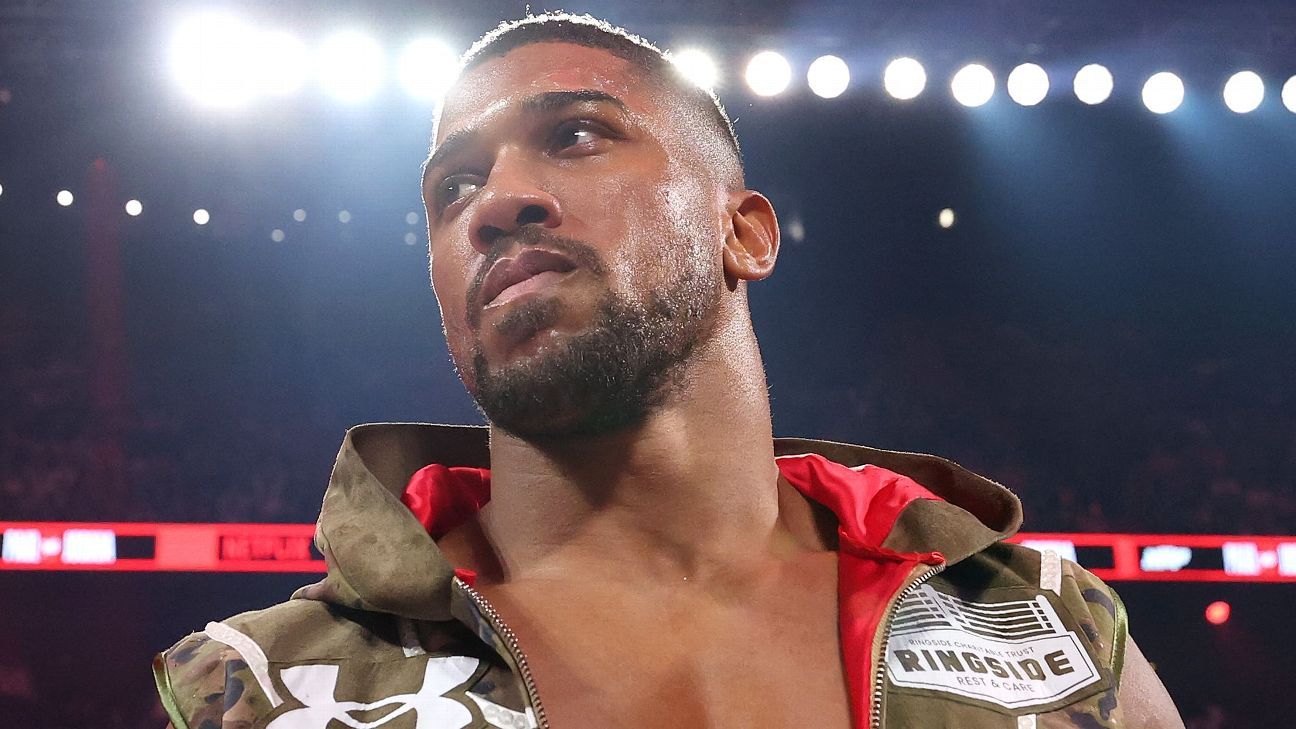
Anthony Joshua tragically lost two friends, his surroundings were always a source of strength
Published
8 months agoon
Years ago, Anthony Joshua deflected criticism over a photo of 23 members of his inner circle in the locker room, doubling down to win his rematch with Andy Ruiz Jr.
Critics complained that the photo Joshua posted was evidence of someone holding him down, suggesting that some of his huge support system were there for their own gain.
His final defeat to Ruiz Jr. served as evidence to support this thesis – some assumed that fans would forget him once his unbeaten streak came to an end.
But that didn’t happen. This was never supposed to happen. Instead, the camaraderie around Joshua strengthened and inspired him to make up for the mistakes he made in his first fight with Ruiz Jr.
“Some of them weren’t on the payroll,” a friend of Joshua’s said at the time of the photo that sparked furor. Some of them were Matchroom employees. Some found time to come themselves. There was also his boxing team – trainers, physiotherapists, dieticians.
“Every organization has people behind the scenes. But there is a stigma from those around you or the fans.
“People who weren’t getting paid were there for love and support. Ask yourself: If your partner was a world champion and needed support, would you give it to him?”
Two of these colleagues tragically died on Monday in Nigeria in a car accident in which Joshua suffered minor injuries.
Sina Ghami was Joshua’s strength and conditioning coach. Latif Ayodele aka “Latz” was a personal trainer.
The two were close friends, vacationing with Joshua after his fight with Jake Paul.
Shockingly, hours before their fatal accident, Joshua posted footage of himself and Ayodele playing table tennis on social media.
Both friends have been by Joshua’s side for years, almost from the beginning of his incredible career.
They were two of the many friends and confidants that Joshua says he is surrounded by.
Many of the people who are still by Joshua’s side were with him as he built his heavyweight career and climbed towards a world title.
It’s a testament to the true friendship in this circle that no one has ever been too tempted by fame, no one has ever used Joshua as a springboard to create their own brand. They have been a true band of brothers since Joshua was throwing professional punches.
The circle of friends has been strengthened by professionals occupying significant positions around Joshua, but even most of these faces have remained unchanged over the years. Loyalty isn’t just something Joshua preaches.
Joshua has previously holidayed in Nigeria with friends.
His parents are Nigerian, and as a teenage man he was briefly sent to school in the African country.
In 2019, after intense scrutiny of Ruiz Jr.’s upset. and his future in boxing, the place Joshua went for his soul searching was Nigeria. It was the first time he had returned to the country since he was a child.
He ventured into the slums of Makoko, a makeshift city built on stilts in the water and transported there by boat.
Joshua recalled his trip to Nigeria with emotion: “I could have won 10 titles, landed at Heathrow and no one was waiting for me except my mother and cousin.
– When did I land at the airport there?
The great heavyweight had to stop talking, caught up in the emotions of his roots.
Many years later, tragedy struck in Nigeria.
Talks about his next fight, either in February or with Tyson Fury in the summer, have rightly been shelved and will remain hidden for some time.
The boxing community – including heavyweights Joshua respects and those he calls rivals – gathered to honor the lives lost on Monday.
Joshua is always at the center of other heavyweights’ thoughts, but now it’s for a different reason – the boxer is in the background and his grieving friend takes priority.
You may like
Boxing
Why Damian Knybas Claims Fail to Prove Andy Ruizs Comeback
Published
3 hours agoon
September 4, 2026

The couch admission reinforces the criticism rather than answering it.
Knyba Can Make Ruiz Look His Age
Knyba lacks elite credentials, but his six-foot-seven frame and 86-inch reach present an awkward test for a short heavyweight returning from more than two years away. A persistent jab, movement, and clinching can prevent Ruiz from reaching the inside, where his hand speed carries the most value.
The former champion should win, particularly because Kabayel exposed Knyba’s difficulty handling sustained pressure. The question is how long Ruiz needs to find his range and how many punches he can produce once the fight extends beyond the early rounds.
The scale provides one encouraging sign. Ruiz was 268 pounds when he stopped Anthony Joshua in June 2019, then ballooned to 283.7 for their rematch. He weighed 274.4 against Jarrell Miller and faded following a fast start. Ruiz came in at 254.3 pounds Thursday, his lightest weight since 2018.
That shows he trained without establishing that his reflexes and conditioning have returned.
Nearly Seven Years Cannot Be Recovered
Since losing the Joshua rematch in December 2019, Ruiz has fought only three times. At 36, the former champion must do more than flatten a carefully selected opponent. He needs frequent fights against progressively stronger heavyweights.
Knyba offers Ruiz activity and confidence, nothing more. Beating him cannot erase nearly seven years of inconsistency or confirm that Ruiz remains among the elite. The real evidence will come later, if Ruiz follows through on his plan to fight again in December.

Boxing
Tommy Hitman Hearns Reflects on His Powerful Knockout Victory Over Barkley
Published
6 hours agoon
September 4, 2026

Barkley brought a 24-4 record and little of Hearns’ glamour. The Bronx pressure fighter had already failed in one title bid, losing a 15-round decision to Sumbu Kalambay in 1987. A fifth-round stoppage of Michael Olajide earned him another opportunity, but the 4-1 odds reflected how the public viewed it. Barkley was tough enough to absorb punishment, not skilled enough to defeat Hearns.
Those opening two rounds supported that judgment. Hearns controlled the distance with his long jab, drove right hands through Barkley’s guard, and ripped punches into the body. A cut opened above Barkley’s left eye in the first round. By the end of the second, he had also suffered a cut over his right eye and a laceration on his lower lip.
Each judge had Hearns ahead 20-18. He had landed 52 percent of his 157 punches, compared with 31 percent of 122 for Barkley. Attempting 157 in slightly more than eight minutes also revealed the risk hidden inside his dominance. He was not content to conduct a long-range boxing lesson. He kept stepping within Barkley’s reach to deliver sustained power combinations.
Such aggression ran against the safest strategy available to Hearns. His height, reach, jab, and superior hand speed allowed him to score without accepting equal danger. Once Barkley began bleeding, however, Hearns fought as though a stoppage was waiting to be collected. Instead of using his legs after each attack, he stayed in range to admire his work and reload.
Attacking the body was effective, but it required Hearns to spend more time at midrange. Barkley was being hurt without being physically displaced. Every combination gave him another chance to recognize when Hearns entered, which hand returned slowly, and where the champion moved after finishing.
Although Hearns had carried his power through several divisions, the added muscle did not eliminate defensive habits formed at lighter weights. He often held his lead hand near his waist before snapping the flicker jab upward from an unusual angle. Against shorter welterweights, that style made the jab difficult to read and created a long barrier they had to cross.
At 6-foot-1 and 160 pounds, Barkley was neither markedly shorter nor physically fragile. He possessed the thicker upper body of a natural middleweight, absorbed punches that had overwhelmed smaller opponents, and retained enough strength to throw with full force after taking sustained punishment.
Those injuries increased the urgency. With cuts above both eyes and another on his lip, Barkley could not count on receiving unlimited time. A cautious response would have let Hearns keep widening the lead while the damage worsened. Barkley instead accepted that he might have only a few opportunities left and began searching for one decisive counter.
Hearns’ low lead hand supplied the target. He repeatedly jabbed, lowered his left glove, and moved in the same direction after punching. Barkley started tracking that exit. He did not need to match Hearns’ speed if he could anticipate where the champion’s head would be.
Late in the third, Hearns jabbed and drifted to his left with the lead hand dropping. Barkley did not answer with a standard straight punch. His right hand traveled in an arc over the downward path of Hearns’ glove and entered the blind spot produced by the champion’s upright retreat.
It landed flush and instantly separated Hearns from his legs. Another right sent him flat onto his back.
Although Hearns managed to rise before referee Richard Steele completed the count, standing was not the same as recovering. His legs crossed beneath him, his posture remained unstable, and he could not establish a defensive position. Steele gave him an opportunity to continue because he had beaten the count, then watched Barkley drive him helplessly backward through the ropes.
Stopping the fight at 2:39 of the third round prevented Barkley from landing further unreturned punches. Steele did not need to diagnose what Hearns was seeing. The champion’s equilibrium and inability to protect himself supplied enough evidence.
Offensive control can conceal defensive danger, as the finish demonstrated. Hearns had the faster hands, straighter punches, and greater command of range. His high output magnified the cost of every lapse, while his desire to force a stoppage repeatedly placed him where Barkley’s heavier, looping punches could reach him.
Victory still required exceptional risk tolerance from Barkley. He had to withstand the jab, body shots, and right hands while staying within countering range. Bloodied and falling behind, he recognized one repeated flaw and committed fully to exploiting it.
The Ring named Barkley’s victory its 1988 Upset of the Year. Hearns briefly discussed retirement, then returned to defeat James Kinchen for the inaugural WBO super middleweight title. Barkley lost the WBC belt to Roberto Duran in his first defense the following February.
Four years later, Barkley challenged Hearns for the WBA light-heavyweight championship on March 20, 1992. In the fourth round, he countered a Hearns right hand with a left hook to score the fight’s only knockdown. That moment proved decisive when Barkley earned a split decision after 12 punishing rounds.
Barkley remains the only boxer to defeat Hearns twice. The first victory required him to survive a beating, identify one repeated flaw, and trust that a single right hand could erase everything that had happened before it.
Photo: AI-improved.

BoxingNews24.com has delivered independent boxing coverage since 2007, including original news, fight analysis, schedules, and results. Our experienced boxing writers cover major fighters and events worldwide, with published content reviewed by editors for accuracy, clarity, and reliable sourcing.
Boxing
Ryan Garcia Reveals Undefeated Legend Assisting Conor Benn in Fight Preparation
Published
10 hours agoon
September 4, 2026
Ryan Garcia will defend his WBC welterweight world title against Conor Benn next weekend, but the Californian believes that an undefeated legend is helping to train his opponent ahead of the fight.
Garcia claimed the title with an impressive triumph over Mario Barrios back in February and he now hopes that he can fulfil his potential and become the face of boxing, beginning with a high-profile clash with Benn.
Should he be victorious, ‘King Ry’ is eyeing up unification bouts against either Teofimo Lopez (WBA champion) or a rematch against WBO titleholder Devin Haney, as well a potential showdown with recently-retired pound-for-pound king Terence Crawford.
In a clip captured by The Ariel Helwani ShowGarcia revealed that he is aware that Crawford is currently helping Benn prepare for the contest, but believes that the assistance of ‘Bud’ will be of little use.
“You notice what they all have in common? They all sound bitter and hateful. Nothing good comes out of that, ever. They are all obviously bitter. I don’t really care what they think, at the end of the day, they can’t fight for Conor Benn, at all. They can’t punch for him.
“I know that Crawford is at Conor Benn’s gym, trying to give him every technique that he can give him, that s**t ain’t gonna help because I feel like I would beat your a**, so what are you gonna teach him?”
Garcia-Benn will go ahead on Saturday, September 12, at the T-Mobile Arena in Las Vegas, with Benn set to move up in weight straight afterwardsregardless of the outcome of the fight.
Tyson Fury says he’ll move on from Anthony Joshua after latest stalemate
Why Damian Knybas Claims Fail to Prove Andy Ruizs Comeback
Dana White says fans will lose their minds for UFC Hawaii
Trending
-
MMA2 days agoGregory Rodrigues admits glove grab, denies cheating vs. Anthony Hernandez
-
MMA2 days agoChute Boxe’s Diego Lima vows to keep Allan Nascimento’s name alive
-
MMA1 day agoFirst UFC 334 fight revealed for Madison Square Garden card
-
MMA2 days agoMarlon Vera made difficult change to avoid one regret at end of UFC career
-
MMA1 day agoAnthony Wint says gambling addiction was bigger battle than 2 UFC fights
-
MMA2 days agoMichael Page slams ‘entitlement issues’ among top UFC welterweights
-
Boxing1 day agoTyson Fury Reveals Next Opponent Wish, Casts Doubts on Anthony Joshua Showdown
-
Boxing1 day agoShakur Stevenson Responds to Rival World Champion Avoidance Accusations: I Make Him Nervous